 Image 1 of 1
Vanilla Tahitensis
A 3 node cutting of a Vanilla tahitensis vine.
Vanilla Tahitensis (Tahitian Vanilla)
Elevate your culinary garden with the orchid behind the world’s most luxurious pastry ingredient. Vanilla tahitensis, widely known as Tahitian Vanilla, offers a remarkably different aromatic profile and growth habit than standard commercial vanilla, making it a highly sought-after prize for both rare orchid collectors and gourmet chefs.
A Botanical Curiosity: Brief History
While its name suggests an origin in the South Pacific, Vanilla tahitensis actually traces its roots back to Mesoamerica. Modern genetic testing has revealed that it is not a naturally occurring wild species, but rather a rare, natural hybrid between the classic Vanilla planifolia and the rarer Vanilla odorata.
It was introduced to French Polynesia in the mid-19th century by French Admiral Francois Alphonse Hamelin. There, in the unique microclimate of Tahiti, it flourished and developed its signature characteristics. Today, Tahitian vanilla commands a premium in the culinary world due to its high levels of heliotropin-a compound that gives the beans a distinctly floral, fruity, and almost anise-like aroma that differs completely from the traditional creamy, woody notes of standard Madagascar vanilla.
Plant Anatomy
The Vine
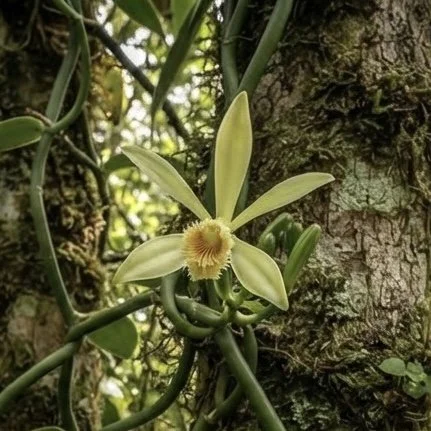
Compared to its famous parent V. planifolia, the vine of Vanilla tahitensis is noticeably more delicate and slender. It features a pronounced "zig-zag" growth pattern between the nodes. The leaves are also narrower, softer, and less fleshy than standard vanilla. As a vigorous monopodial climber, it rapidly sends out aerial roots at each node to grip its host tree or trellis and absorb essential ambient moisture.
The Flower
The blooms of Tahitian Vanilla are elegant, waxy, and relatively large, measuring about 2 to 3 inches across. They possess pale greenish-yellow sepals and petals, framing a distinctively ruffled, tubular lip. Like most vanillas, these stunning flowers are highly ephemeral-they open in the early morning and close by mid-afternoon on the exact same day. To produce a bean outside of its naturalized habitat, the flower must be carefully hand-pollinated during this short window.
The Bean
When successfully pollinated, the flower yields a seed pod that is characteristically different from standard vanilla. Tahitian vanilla beans are noticeably shorter, plumper, and contain a higher moisture and oil content. Crucially, unlike V. planifolia, Tahitian vanilla pods do not split open (dehisce) as soon as they ripen on the vine, which allows them to fully mature and develop their complex, fruity aromatic compounds before harvesting.
Growing & Care Instructions
Growing Vanilla tahitensis is a rewarding challenge that requires mimicking a warm, deeply humid tropical environment.
Light: Provide bright, indirect, or filtered sunlight. It thrives in dappled canopy shade. Direct, harsh midday sun will quickly scorch the delicate, narrow leaves and stunt the plant's growth.
Support (The Host): This plant is a climbing vine that must be trained upward to mature and eventually bloom. Provide a sturdy, rough-textured support such as a moss pole, a cedar post wrapped in coco coir, or a living tree.
Water & Humidity: Vanilla tahitensis demands high, consistent moisture. Water thoroughly, keeping the potting medium lightly moist but never completely waterlogged. Ambient humidity is critical and should be maintained between 75% and 85% to ensure the aerial roots remain healthy and plump.
Potting Medium: Plant the terrestrial base in a highly aerated, fast-draining epiphytic mix. A blend of medium orchid bark, perlite, and a handful of high-quality sphagnum moss or humus perfectly mimics the rich, airy forest floor.
Temperature: This is a strictly tropical species that loves heat. It thrives in consistent temperatures between 75F and 90F. It can be grown outdoors year-round in USDA Zones 11-12, but must be grown in a heated greenhouse or a warm, humid indoor environment in any cooler climate. Protect it completely from temperatures below 60F.
Fertilization: Apply a well-balanced, water-soluble orchid fertilizer at quarter or half strength every one to two weeks during the active spring and summer growing seasons.
A 3 node cutting of a Vanilla tahitensis vine.
Vanilla Tahitensis (Tahitian Vanilla)
Elevate your culinary garden with the orchid behind the world’s most luxurious pastry ingredient. Vanilla tahitensis, widely known as Tahitian Vanilla, offers a remarkably different aromatic profile and growth habit than standard commercial vanilla, making it a highly sought-after prize for both rare orchid collectors and gourmet chefs.
A Botanical Curiosity: Brief History
While its name suggests an origin in the South Pacific, Vanilla tahitensis actually traces its roots back to Mesoamerica. Modern genetic testing has revealed that it is not a naturally occurring wild species, but rather a rare, natural hybrid between the classic Vanilla planifolia and the rarer Vanilla odorata.
It was introduced to French Polynesia in the mid-19th century by French Admiral Francois Alphonse Hamelin. There, in the unique microclimate of Tahiti, it flourished and developed its signature characteristics. Today, Tahitian vanilla commands a premium in the culinary world due to its high levels of heliotropin-a compound that gives the beans a distinctly floral, fruity, and almost anise-like aroma that differs completely from the traditional creamy, woody notes of standard Madagascar vanilla.
Plant Anatomy
The Vine
Compared to its famous parent V. planifolia, the vine of Vanilla tahitensis is noticeably more delicate and slender. It features a pronounced "zig-zag" growth pattern between the nodes. The leaves are also narrower, softer, and less fleshy than standard vanilla. As a vigorous monopodial climber, it rapidly sends out aerial roots at each node to grip its host tree or trellis and absorb essential ambient moisture.
The Flower
The blooms of Tahitian Vanilla are elegant, waxy, and relatively large, measuring about 2 to 3 inches across. They possess pale greenish-yellow sepals and petals, framing a distinctively ruffled, tubular lip. Like most vanillas, these stunning flowers are highly ephemeral-they open in the early morning and close by mid-afternoon on the exact same day. To produce a bean outside of its naturalized habitat, the flower must be carefully hand-pollinated during this short window.
The Bean
When successfully pollinated, the flower yields a seed pod that is characteristically different from standard vanilla. Tahitian vanilla beans are noticeably shorter, plumper, and contain a higher moisture and oil content. Crucially, unlike V. planifolia, Tahitian vanilla pods do not split open (dehisce) as soon as they ripen on the vine, which allows them to fully mature and develop their complex, fruity aromatic compounds before harvesting.
Growing & Care Instructions
Growing Vanilla tahitensis is a rewarding challenge that requires mimicking a warm, deeply humid tropical environment.
Light: Provide bright, indirect, or filtered sunlight. It thrives in dappled canopy shade. Direct, harsh midday sun will quickly scorch the delicate, narrow leaves and stunt the plant's growth.
Support (The Host): This plant is a climbing vine that must be trained upward to mature and eventually bloom. Provide a sturdy, rough-textured support such as a moss pole, a cedar post wrapped in coco coir, or a living tree.
Water & Humidity: Vanilla tahitensis demands high, consistent moisture. Water thoroughly, keeping the potting medium lightly moist but never completely waterlogged. Ambient humidity is critical and should be maintained between 75% and 85% to ensure the aerial roots remain healthy and plump.
Potting Medium: Plant the terrestrial base in a highly aerated, fast-draining epiphytic mix. A blend of medium orchid bark, perlite, and a handful of high-quality sphagnum moss or humus perfectly mimics the rich, airy forest floor.
Temperature: This is a strictly tropical species that loves heat. It thrives in consistent temperatures between 75F and 90F. It can be grown outdoors year-round in USDA Zones 11-12, but must be grown in a heated greenhouse or a warm, humid indoor environment in any cooler climate. Protect it completely from temperatures below 60F.
Fertilization: Apply a well-balanced, water-soluble orchid fertilizer at quarter or half strength every one to two weeks during the active spring and summer growing seasons.