 Image 1 of 1
A 3 node cutting of a Vanilla madagascariensis vine.
Vanilla madagascariensis (The Madagascar Vanilla)
Brief History Native exclusively to Madagascar, this species is found scrambling through the canopy of the island's humid eastern tropical forests and western dry forests, from sea level up to roughly 2,600 feet. It is part of a highly specialized evolutionary complex of leafless vanillas native to the South-West Indian Ocean region. Closely related to the African Vanilla roscheri, Vanilla madagascariensis evolved to completely abandon its foliage as an adaptation to survive periods of intense heat and drought in its native habitat.
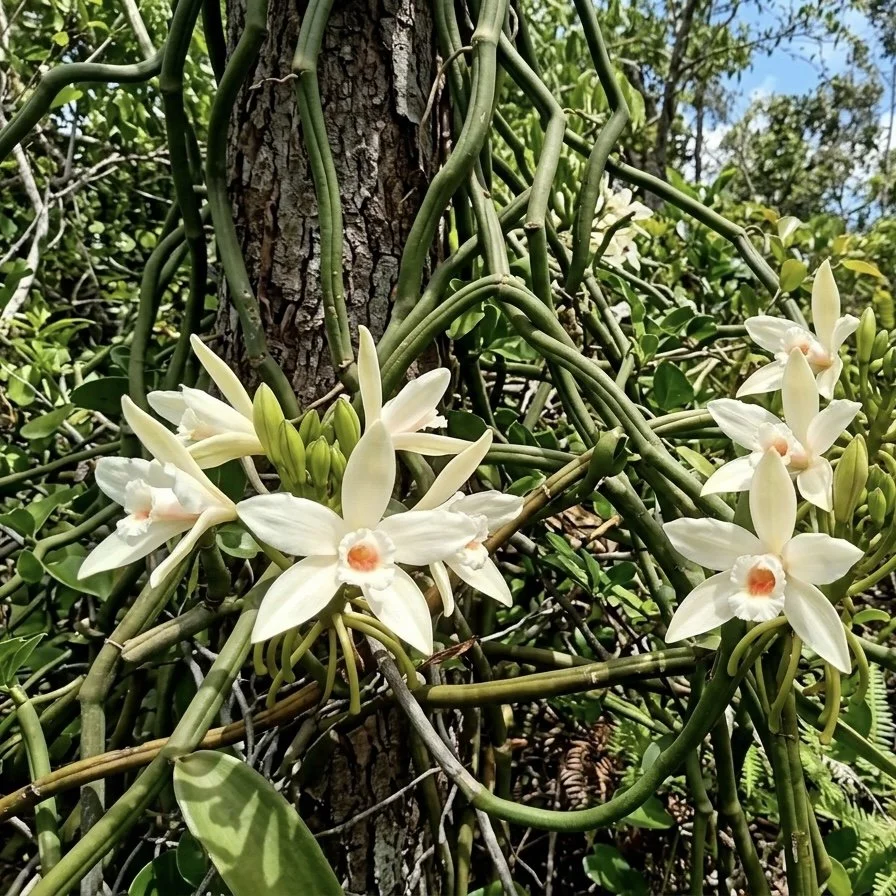
Vine and Flower Description Like V. aphylla and V. roscheri, this is an aphyllous (leafless) climbing liana. It features thick, fleshy, grayish-green succulent stems that perform all of the plant’s photosynthesis. These stems are highly branched and can reach lengths of over 20 feet in the wild, scaling trees or hanging down pendulously. It relies on thick, rubbery, sap-filled adventitious roots to anchor its heavy weight to its host.
The flowers are among the most spectacular in the entire genus. Produced in large clusters of 10 to 20 buds, the massive blooms feature pure, crisp white petals and sepals. The standout characteristic is its highly modified, trumpet-shaped lip (labellum), which is intensely flushed with a deep rose-carmine, apricot, or red throat.
Necessary Growing Conditions Because it originates from Madagascar's tropical forests, this species thrives in heat and high humidity, making it a fantastic candidate for the climate of Central Florida. It will acclimate beautifully to a custom shade house environment, providing a dramatic, architectural visual contrast when grown alongside the broad, lush vines of your Vanilla pompona and Painters Planifolia.
While it appreciates ambient moisture (ideally 50% to 70% humidity), its leafless adaptation makes it somewhat drought-tolerant. It is, however, highly susceptible to root rot if the base is kept waterlogged. Plant it in a very coarse, fast-draining epiphytic substrate-such as large-grade orchid bark, coconut husk, or perlite-and allow the root zone to dry out slightly between waterings. It requires bright, filtered sunlight (partial sun) and a very sturdy vertical support, like a heavy wooden post or trellis, for its thick roots to grip as it vigorously branches and climbs.
A 3 node cutting of a Vanilla madagascariensis vine.
Vanilla madagascariensis (The Madagascar Vanilla)
Brief History Native exclusively to Madagascar, this species is found scrambling through the canopy of the island's humid eastern tropical forests and western dry forests, from sea level up to roughly 2,600 feet. It is part of a highly specialized evolutionary complex of leafless vanillas native to the South-West Indian Ocean region. Closely related to the African Vanilla roscheri, Vanilla madagascariensis evolved to completely abandon its foliage as an adaptation to survive periods of intense heat and drought in its native habitat.
Vine and Flower Description Like V. aphylla and V. roscheri, this is an aphyllous (leafless) climbing liana. It features thick, fleshy, grayish-green succulent stems that perform all of the plant’s photosynthesis. These stems are highly branched and can reach lengths of over 20 feet in the wild, scaling trees or hanging down pendulously. It relies on thick, rubbery, sap-filled adventitious roots to anchor its heavy weight to its host.
The flowers are among the most spectacular in the entire genus. Produced in large clusters of 10 to 20 buds, the massive blooms feature pure, crisp white petals and sepals. The standout characteristic is its highly modified, trumpet-shaped lip (labellum), which is intensely flushed with a deep rose-carmine, apricot, or red throat.
Necessary Growing Conditions Because it originates from Madagascar's tropical forests, this species thrives in heat and high humidity, making it a fantastic candidate for the climate of Central Florida. It will acclimate beautifully to a custom shade house environment, providing a dramatic, architectural visual contrast when grown alongside the broad, lush vines of your Vanilla pompona and Painters Planifolia.
While it appreciates ambient moisture (ideally 50% to 70% humidity), its leafless adaptation makes it somewhat drought-tolerant. It is, however, highly susceptible to root rot if the base is kept waterlogged. Plant it in a very coarse, fast-draining epiphytic substrate-such as large-grade orchid bark, coconut husk, or perlite-and allow the root zone to dry out slightly between waterings. It requires bright, filtered sunlight (partial sun) and a very sturdy vertical support, like a heavy wooden post or trellis, for its thick roots to grip as it vigorously branches and climbs.