 Image 1 of 1
A 3 node cutting of a Vanilla perrierii vine.
Vanilla perrieri (Perrier's Vanilla)
Brief History Native to the western and southern regions of Madagascar, Vanilla perrieri was first described in 1924 and named in honor of the French botanist Henri Perrier de la Bathie, who extensively studied Madagascar's flora in the early 1900s. In the wild, this rare orchid is found clinging to trees in seasonally dry, deciduous forests on sandy soils at relatively low elevations (around 650 to 1,150 feet). It belongs to a specialized evolutionary group of leafless vanillas native to the region and is closely related to Vanilla humblotii and the Vanilla madagascariensis complex.
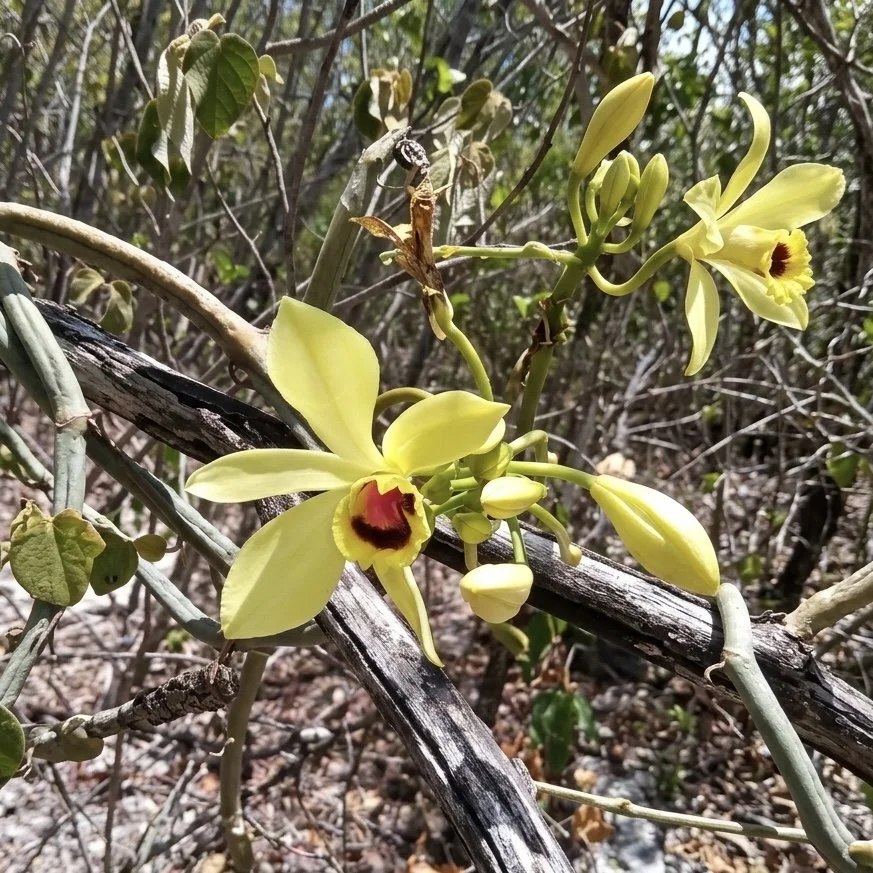
Vine and Flower Description Like its cousin V. madagascariensis, Vanilla perrieri is a striking, leafless (aphyllous) epiphyte. It relies entirely on long, highly branching, grayish-green succulent stems for photosynthesis, having abandoned broad leaves to conserve water during the harsh dry seasons of its native habitat. As the heavy vine vigorously climbs, it sends out robust adventitious roots that readily grip onto almost any rough, vertical support.
The sweet-smelling flowers are exceptionally vivid and distinct from other leafless vanillas. Blooming in the spring and summer, the plant produces clusters of 10 to 20 buds that open successively. Each bloom features bright, lemon-yellow petals and sepals. The most arresting feature is the tubular lip, which showcases a dramatically contrasting, dark brownish-maroon throat. It is worth noting that the vine typically needs to reach at least 3 feet in length before it is mature enough to flower.
Necessary Growing Conditions Originating from the hot, seasonally dry forests of Madagascar, this species is heavily adapted to heat and is extremely well-suited for a warm, humid climate like Central Florida. It will thrive in a custom shade house, where its bare, sprawling grayish-green stems will provide fantastic architectural and visual contrast alongside the lush, broad foliage of your Painters Planifolia and Vanilla pompona.
Because it is adapted to periods of drought, it is highly sensitive to overwatering and root rot. Plant the base in a very coarse, fast-draining epiphytic mix (such as large-grade orchid bark, perlite, and charcoal) rather than a dense terrestrial soil, and allow the root zone to dry out fully between waterings. It requires intermediate to warm temperatures, bright but filtered sunlight, and a very sturdy vertical mount. Heavy wooden posts, rough bark slabs, or even thick structural bamboo poles make exceptional natural mounts for its roots to aggressively anchor onto as it scales.
A 3 node cutting of a Vanilla perrierii vine.
Vanilla perrieri (Perrier's Vanilla)
Brief History Native to the western and southern regions of Madagascar, Vanilla perrieri was first described in 1924 and named in honor of the French botanist Henri Perrier de la Bathie, who extensively studied Madagascar's flora in the early 1900s. In the wild, this rare orchid is found clinging to trees in seasonally dry, deciduous forests on sandy soils at relatively low elevations (around 650 to 1,150 feet). It belongs to a specialized evolutionary group of leafless vanillas native to the region and is closely related to Vanilla humblotii and the Vanilla madagascariensis complex.
Vine and Flower Description Like its cousin V. madagascariensis, Vanilla perrieri is a striking, leafless (aphyllous) epiphyte. It relies entirely on long, highly branching, grayish-green succulent stems for photosynthesis, having abandoned broad leaves to conserve water during the harsh dry seasons of its native habitat. As the heavy vine vigorously climbs, it sends out robust adventitious roots that readily grip onto almost any rough, vertical support.
The sweet-smelling flowers are exceptionally vivid and distinct from other leafless vanillas. Blooming in the spring and summer, the plant produces clusters of 10 to 20 buds that open successively. Each bloom features bright, lemon-yellow petals and sepals. The most arresting feature is the tubular lip, which showcases a dramatically contrasting, dark brownish-maroon throat. It is worth noting that the vine typically needs to reach at least 3 feet in length before it is mature enough to flower.
Necessary Growing Conditions Originating from the hot, seasonally dry forests of Madagascar, this species is heavily adapted to heat and is extremely well-suited for a warm, humid climate like Central Florida. It will thrive in a custom shade house, where its bare, sprawling grayish-green stems will provide fantastic architectural and visual contrast alongside the lush, broad foliage of your Painters Planifolia and Vanilla pompona.
Because it is adapted to periods of drought, it is highly sensitive to overwatering and root rot. Plant the base in a very coarse, fast-draining epiphytic mix (such as large-grade orchid bark, perlite, and charcoal) rather than a dense terrestrial soil, and allow the root zone to dry out fully between waterings. It requires intermediate to warm temperatures, bright but filtered sunlight, and a very sturdy vertical mount. Heavy wooden posts, rough bark slabs, or even thick structural bamboo poles make exceptional natural mounts for its roots to aggressively anchor onto as it scales.