 Image 1 of 1
A 3 node cutting of a Vanilla borneensis vine.
Vanilla borneensis (The East Indian Vanilla)
Brief History Native to the warm, humid regions of Southeast Asia, Vanilla borneensis (also known historically by its synonym Vanilla pilifera) was first identified by botanist Robert Allen Rolfe in 1896. Its natural habitat spans across northeastern India (particularly Assam, where it is considered a rare and critically endangered terrestrial and epiphytic orchid), Thailand, Malaysia, and Borneo. In the wild, it is found scrambling through the canopies of dry evergreen and peat swamp forests from sea level up to roughly 1,300 feet (400 meters) in elevation.
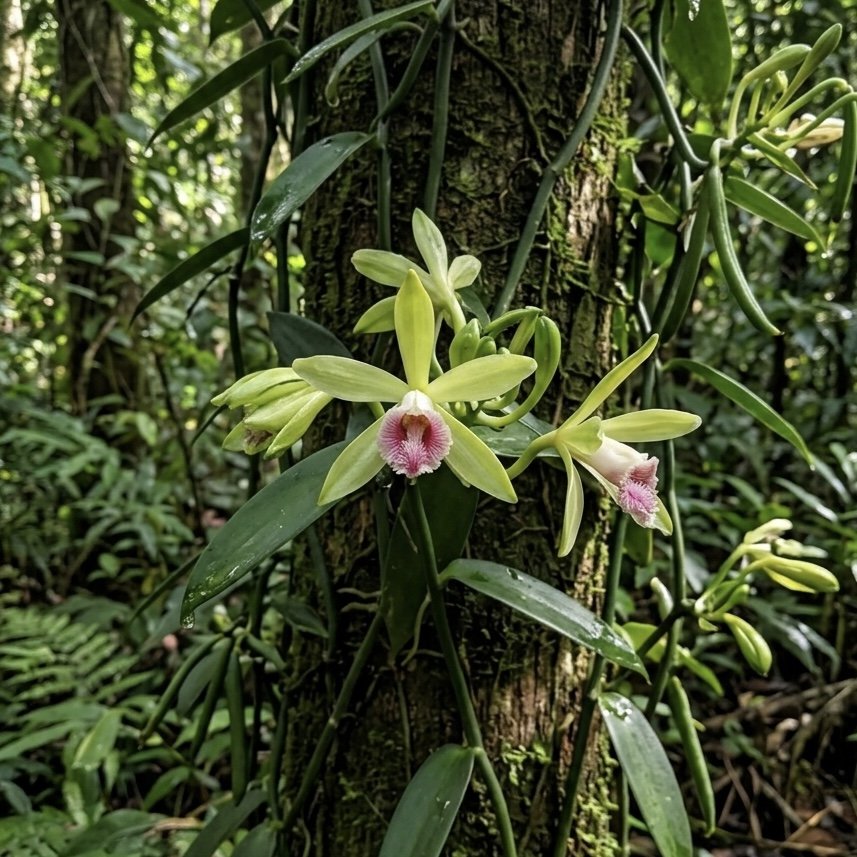
Vine and Flower Description Unlike the leafless varieties, Vanilla borneensis is a robust, leafy, monopodial climber capable of reaching several meters in length. It features elongated, cylindrical green stems that are longitudinally grooved and roughly a quarter-inch (3-7 mm) thick. The vine produces leathery, lance-shaped leaves with an abrupt, narrow tip that grow between 3 and 7 inches (8-18 cm) long. Thin, tendril-like aerial roots emerge perpendicularly from the nodes to firmly anchor the plant to its support.
The highly fragrant blooms emerge in the winter and early spring on inflorescences holding 5 to 15 flowers. Each showy flower measures about 2.7 inches (6.8 cm) across, featuring greenish-yellow petals and sepals. The standout feature is its obscurely three-lobed lip, which transitions from white to pale pink with purple markings, accented by a distinct, deeply fringed, downward-pointing hairy "brush" on the central disc.
Necessary Growing Conditions As a hot-to-warm growing epiphyte that thrives in high humidity, Vanilla borneensis is an excellent candidate for the climate of Central Florida. It will seamlessly integrate into a custom shade house habitat, providing a classic, lush broad-leaf aesthetic that beautifully complements your Painters Planifolia and Vanilla pompona.
It requires a sturdy vertical mount, such as a wooden trellis or a tree trunk, for its aerial roots to grip as it scales upward. Plant the base in a highly aerated, well-draining epiphytic or terrestrial mix-such as medium orchid bark blended with perlite and a bit of peat-ensuring the root zone remains damp but never waterlogged. Provide bright, filtered sunlight (partial shade) and maintain high ambient moisture to replicate the muggy, tropical canopies of its native Southeast Asian forests.
A 3 node cutting of a Vanilla borneensis vine.
Vanilla borneensis (The East Indian Vanilla)
Brief History Native to the warm, humid regions of Southeast Asia, Vanilla borneensis (also known historically by its synonym Vanilla pilifera) was first identified by botanist Robert Allen Rolfe in 1896. Its natural habitat spans across northeastern India (particularly Assam, where it is considered a rare and critically endangered terrestrial and epiphytic orchid), Thailand, Malaysia, and Borneo. In the wild, it is found scrambling through the canopies of dry evergreen and peat swamp forests from sea level up to roughly 1,300 feet (400 meters) in elevation.
Vine and Flower Description Unlike the leafless varieties, Vanilla borneensis is a robust, leafy, monopodial climber capable of reaching several meters in length. It features elongated, cylindrical green stems that are longitudinally grooved and roughly a quarter-inch (3-7 mm) thick. The vine produces leathery, lance-shaped leaves with an abrupt, narrow tip that grow between 3 and 7 inches (8-18 cm) long. Thin, tendril-like aerial roots emerge perpendicularly from the nodes to firmly anchor the plant to its support.
The highly fragrant blooms emerge in the winter and early spring on inflorescences holding 5 to 15 flowers. Each showy flower measures about 2.7 inches (6.8 cm) across, featuring greenish-yellow petals and sepals. The standout feature is its obscurely three-lobed lip, which transitions from white to pale pink with purple markings, accented by a distinct, deeply fringed, downward-pointing hairy "brush" on the central disc.
Necessary Growing Conditions As a hot-to-warm growing epiphyte that thrives in high humidity, Vanilla borneensis is an excellent candidate for the climate of Central Florida. It will seamlessly integrate into a custom shade house habitat, providing a classic, lush broad-leaf aesthetic that beautifully complements your Painters Planifolia and Vanilla pompona.
It requires a sturdy vertical mount, such as a wooden trellis or a tree trunk, for its aerial roots to grip as it scales upward. Plant the base in a highly aerated, well-draining epiphytic or terrestrial mix-such as medium orchid bark blended with perlite and a bit of peat-ensuring the root zone remains damp but never waterlogged. Provide bright, filtered sunlight (partial shade) and maintain high ambient moisture to replicate the muggy, tropical canopies of its native Southeast Asian forests.