 Image 1 of 1
A 3 node cutting of a Vanilla polylepis vine.
Vanilla polylepis (The Many-Scaled Vanilla)
Brief History Native to tropical Africa, its natural range spans the width of the continent from Kenya to Angola. It thrives in high-altitude evergreen and swamp forests, typically found clinging to trees that border rivers and waterfalls. The specific epithet polylepis is derived from the Greek words for "many" (poly) and "scale" (lepis), which refers to the distinctive rows of scales found on the flower's lip. Due to its highly localized and fragmented distribution, this rare African orchid is currently listed as an Endangered species.
Vine and Flower Description Unlike leafless varieties, Vanilla polylepis is a vigorous, highly leafy climber capable of reaching lengths of up to 30 feet. The vine features fleshy, intensely bright green, slightly angular stems. It produces large, glossy, lance-shaped leaves that can reach up to 9.5 inches long, alternating along the stem alongside robust white adventitious roots used to anchor the heavy plant to trunks and boulders.
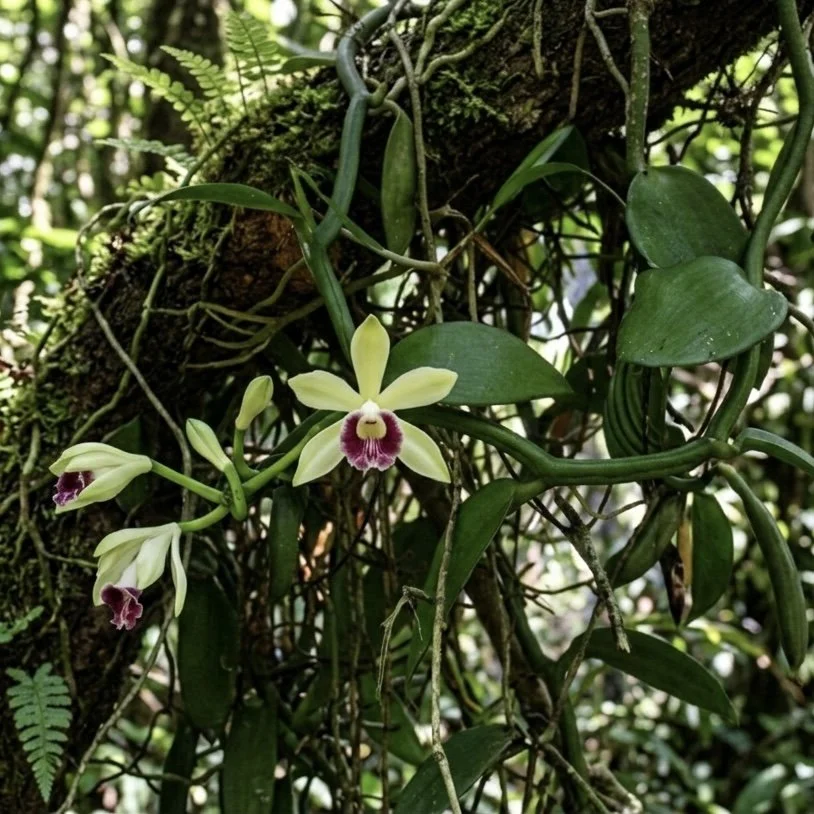
The inflorescences produce large, showy flowers with crisp, greenish-white petals and sepals. The standout feature is its highly modified lip (labellum) -a frilled, pale orange-yellow funnel that terminates in a striking, deep pink-to-maroon blotch at the apex. While a single floral cluster can hold up to 20 buds, only one to three open at a time, each emitting a faint, sweet vanilla fragrance.
Necessary Growing Conditions Because it originates from elevations between 3,900 and 4,900 feet, this species adapts exceptionally well to intermediate and warm environments. It is a perfect addition to a custom shade house habitat, providing dense, lush foliage that beautifully complements Central American species and cultivars like Painters Planifolia and Vanilla pompona.
It requires a sturdy vertical support structure for its aerial roots to grip as it matures. Plant the base in a highly aerated, well-draining terrestrial mix-such as a blend of seedling bark and peat, or pure New Zealand sphagnum moss. Provide bright, filtered sunlight and high ambient humidity (60% to 80%), ensuring the root zone remains consistently damp but never tightly packed or waterlogged.
A 3 node cutting of a Vanilla polylepis vine.
Vanilla polylepis (The Many-Scaled Vanilla)
Brief History Native to tropical Africa, its natural range spans the width of the continent from Kenya to Angola. It thrives in high-altitude evergreen and swamp forests, typically found clinging to trees that border rivers and waterfalls. The specific epithet polylepis is derived from the Greek words for "many" (poly) and "scale" (lepis), which refers to the distinctive rows of scales found on the flower's lip. Due to its highly localized and fragmented distribution, this rare African orchid is currently listed as an Endangered species.
Vine and Flower Description Unlike leafless varieties, Vanilla polylepis is a vigorous, highly leafy climber capable of reaching lengths of up to 30 feet. The vine features fleshy, intensely bright green, slightly angular stems. It produces large, glossy, lance-shaped leaves that can reach up to 9.5 inches long, alternating along the stem alongside robust white adventitious roots used to anchor the heavy plant to trunks and boulders.
The inflorescences produce large, showy flowers with crisp, greenish-white petals and sepals. The standout feature is its highly modified lip (labellum) -a frilled, pale orange-yellow funnel that terminates in a striking, deep pink-to-maroon blotch at the apex. While a single floral cluster can hold up to 20 buds, only one to three open at a time, each emitting a faint, sweet vanilla fragrance.
Necessary Growing Conditions Because it originates from elevations between 3,900 and 4,900 feet, this species adapts exceptionally well to intermediate and warm environments. It is a perfect addition to a custom shade house habitat, providing dense, lush foliage that beautifully complements Central American species and cultivars like Painters Planifolia and Vanilla pompona.
It requires a sturdy vertical support structure for its aerial roots to grip as it matures. Plant the base in a highly aerated, well-draining terrestrial mix-such as a blend of seedling bark and peat, or pure New Zealand sphagnum moss. Provide bright, filtered sunlight and high ambient humidity (60% to 80%), ensuring the root zone remains consistently damp but never tightly packed or waterlogged.