 Image 1 of 2
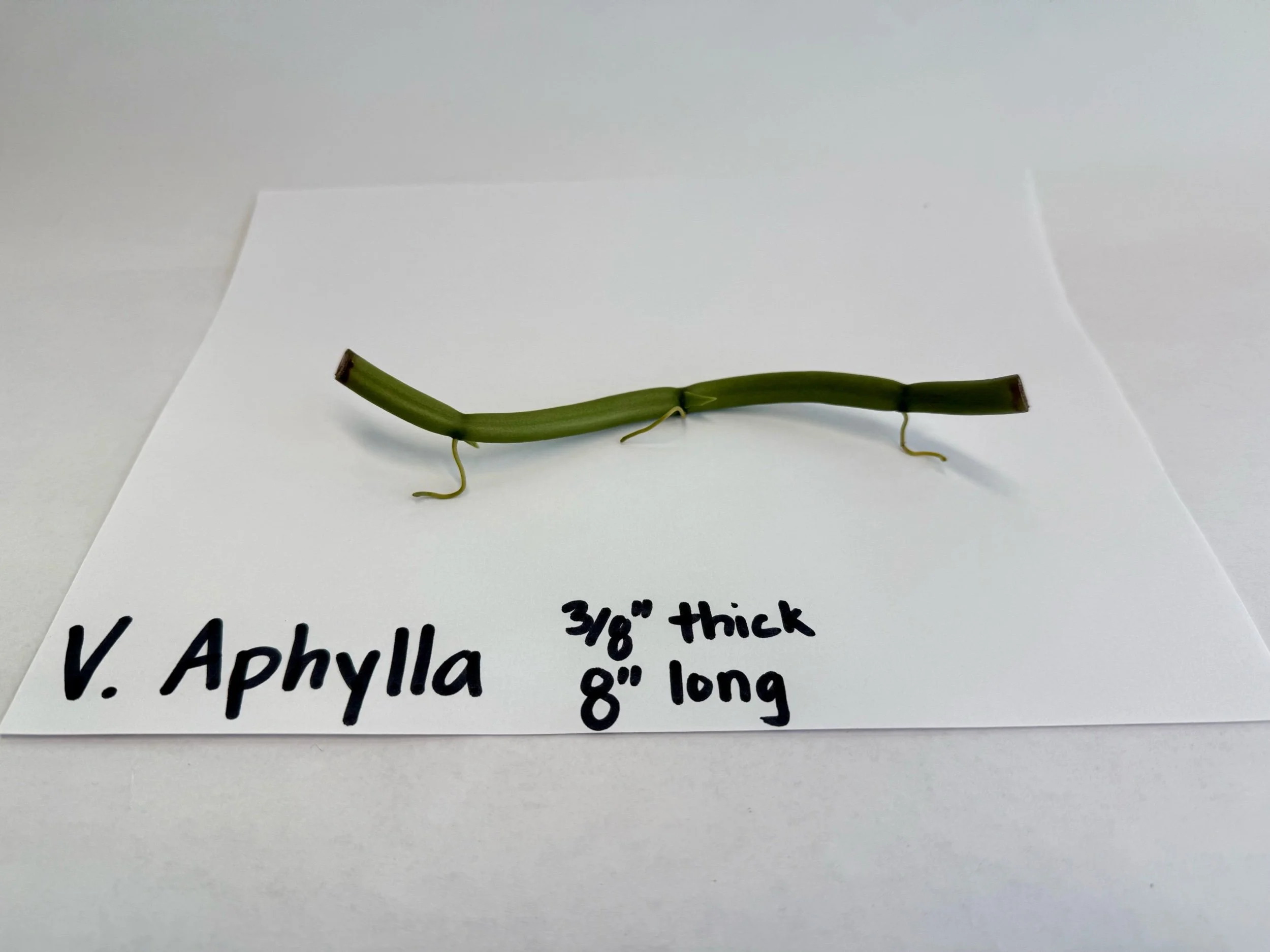 Image 2 of 2
A 3 node cutting of a Vanilla aphylla vine.
Vanilla aphylla (The Leafless Vanilla)
Brief History Native to Southeast Asia-spanning regions from Assam, Laos, Thailand, and Malaysia down to Java-Vanilla aphylla represents a fascinating evolutionary divergence within the Vanilla genus. While the genus itself was established by Plumier in 1754, this specific species (first described by botanist Carl Ludwig Blume) uniquely adapted to its native environments by dropping its traditional foliage altogether to conserve resources.
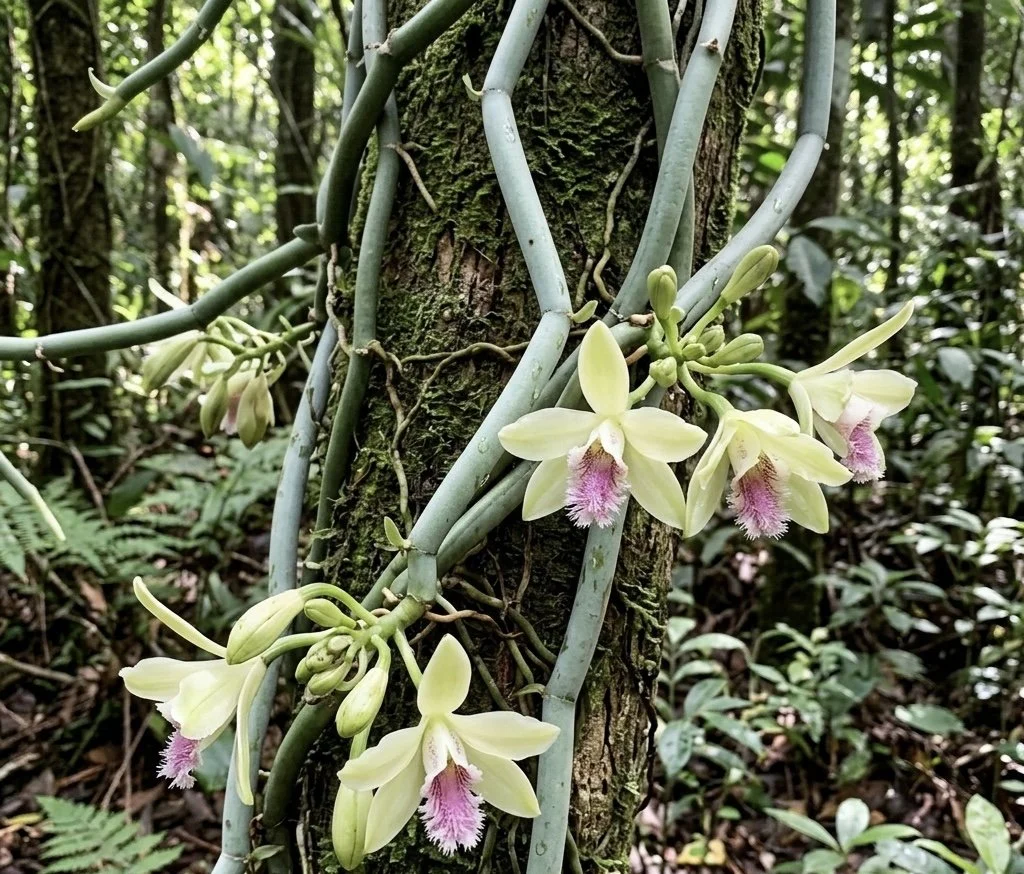
Vine and Flower Description The specific epithet "aphylla" literally translates to "leafless". Instead of the broad, flat foliage common to the genus, this monopodial vine features striking, pencil-thick, dark green succulent stems. With its leaves reduced to tiny, barely visible scales at the nodes, the plant relies entirely on its fleshy climbing stems for photosynthesis. Long, robust aerial roots emerge from each node to firmly anchor the heavy vine to its support structure.
The blooms emerge successively from short peduncles at the nodes. Each flower is roughly 2 inches across, displaying a pale greenish-yellow color with a beautiful trumpet-shaped, tubular lip featuring delicate bristly textures inside. The sweet-scented blooms are short-lived -opening early in the morning and closing permanently by late afternoon.
Necessary Growing Conditions Vanilla aphylla thrives in warm to intermediate environments with temperatures ranging from 60F° to 90F°. Because of its aggressive climbing habit, it requires a sturdy vertical support structure, such as a wooden stake, trellis, or tree trunk, for its adventitious roots to mount.
This species makes an exceptional addition to a custom shade house habitat, providing a striking, architectural visual contrast when cultivated alongside traditional broad-leaved species and cultivars like Vanilla pompona or Painters Planifolia. It prefers bright, filtered light and high ambient humidity (around 80%). Plant it in a highly aerated, well-draining medium like medium bark or sphagnum moss, and allow the root zone to dry out slightly between waterings to prevent rot.
A 3 node cutting of a Vanilla aphylla vine.
Vanilla aphylla (The Leafless Vanilla)
Brief History Native to Southeast Asia-spanning regions from Assam, Laos, Thailand, and Malaysia down to Java-Vanilla aphylla represents a fascinating evolutionary divergence within the Vanilla genus. While the genus itself was established by Plumier in 1754, this specific species (first described by botanist Carl Ludwig Blume) uniquely adapted to its native environments by dropping its traditional foliage altogether to conserve resources.
Vine and Flower Description The specific epithet "aphylla" literally translates to "leafless". Instead of the broad, flat foliage common to the genus, this monopodial vine features striking, pencil-thick, dark green succulent stems. With its leaves reduced to tiny, barely visible scales at the nodes, the plant relies entirely on its fleshy climbing stems for photosynthesis. Long, robust aerial roots emerge from each node to firmly anchor the heavy vine to its support structure.
The blooms emerge successively from short peduncles at the nodes. Each flower is roughly 2 inches across, displaying a pale greenish-yellow color with a beautiful trumpet-shaped, tubular lip featuring delicate bristly textures inside. The sweet-scented blooms are short-lived -opening early in the morning and closing permanently by late afternoon.
Necessary Growing Conditions Vanilla aphylla thrives in warm to intermediate environments with temperatures ranging from 60F° to 90F°. Because of its aggressive climbing habit, it requires a sturdy vertical support structure, such as a wooden stake, trellis, or tree trunk, for its adventitious roots to mount.
This species makes an exceptional addition to a custom shade house habitat, providing a striking, architectural visual contrast when cultivated alongside traditional broad-leaved species and cultivars like Vanilla pompona or Painters Planifolia. It prefers bright, filtered light and high ambient humidity (around 80%). Plant it in a highly aerated, well-draining medium like medium bark or sphagnum moss, and allow the root zone to dry out slightly between waterings to prevent rot.