 Image 1 of 1
A 3 node cutting of a Vanilla humblotii
Vanilla humblotii (Humblot's Vanilla)
Brief History Native to the island of Grande Comore in the Comoros archipelago as well as parts of Madagascar, Vanilla humblotii was named in honor of Laon Humblot, a 19th-century French botanist and naturalist who extensively studied the flora of the region. In the wild, this extremely rare orchid clings to rocks and trees in dry, rocky mountainous terrains and mesophilous (moderate moisture) forests. Today, it is considered an endangered species due to habitat loss and human encroachment, making it a highly prized specimen for conservation-minded collectors.
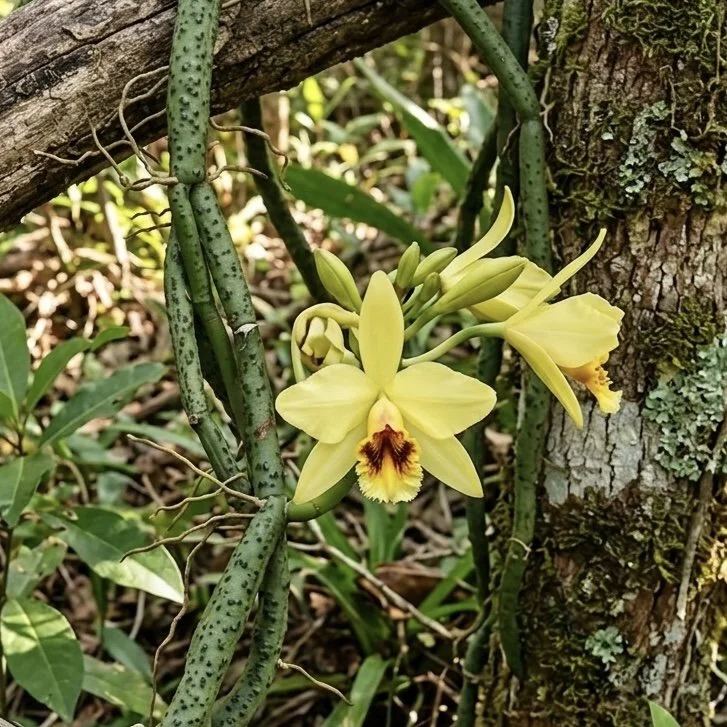
Vine and Flower Description Like several of its Malagasy cousins, Vanilla humblotii is an aphyllous (leafless) climbing liana. To conserve water in its occasionally harsh, dry native habitat, it completely dropped its foliage over its evolutionary history. Instead, photosynthesis takes place entirely within its thick, fleshy, grayish-green succulent stems. A unique characteristic of this vine is the occasionally rough, warty texture found along the internodes of the stems.
The blooms are massive and breathtaking. They feature brilliant, canary-yellow petals and sepals. The undeniable focal point of the flower, however, is its lip (labellum)-a striking, heavily textured funnel adorned with a dense, dark red-to-maroon velvety patch covered in prominent, bristly hairs.
Necessary Growing Conditions Originating from the Comoros and Madagascar, this heat-loving orchid will absolutely thrive in a warm, humid climate like Central Florida's. Within a custom shade house, its stark, leafless, architectural stems will create an incredible visual contrast when grown alongside your broad, lushly foliated Painters Planifolia and Vanilla pompona vines.
Because it is adapted to dry, rocky environments, Vanilla humblotii is extremely susceptible to root rot if kept continually wet. Avoid dense potting soils entirely; instead, plant the base in a highly coarse, rocky, and fast-draining epiphytic mix (such as large-grade bark, lava rock, and charcoal). It requires a very sturdy vertical mount. Provide bright, filtered light and allow the roots to dry out completely between waterings.
A 3 node cutting of a Vanilla humblotii
Vanilla humblotii (Humblot's Vanilla)
Brief History Native to the island of Grande Comore in the Comoros archipelago as well as parts of Madagascar, Vanilla humblotii was named in honor of Laon Humblot, a 19th-century French botanist and naturalist who extensively studied the flora of the region. In the wild, this extremely rare orchid clings to rocks and trees in dry, rocky mountainous terrains and mesophilous (moderate moisture) forests. Today, it is considered an endangered species due to habitat loss and human encroachment, making it a highly prized specimen for conservation-minded collectors.
Vine and Flower Description Like several of its Malagasy cousins, Vanilla humblotii is an aphyllous (leafless) climbing liana. To conserve water in its occasionally harsh, dry native habitat, it completely dropped its foliage over its evolutionary history. Instead, photosynthesis takes place entirely within its thick, fleshy, grayish-green succulent stems. A unique characteristic of this vine is the occasionally rough, warty texture found along the internodes of the stems.
The blooms are massive and breathtaking. They feature brilliant, canary-yellow petals and sepals. The undeniable focal point of the flower, however, is its lip (labellum)-a striking, heavily textured funnel adorned with a dense, dark red-to-maroon velvety patch covered in prominent, bristly hairs.
Necessary Growing Conditions Originating from the Comoros and Madagascar, this heat-loving orchid will absolutely thrive in a warm, humid climate like Central Florida's. Within a custom shade house, its stark, leafless, architectural stems will create an incredible visual contrast when grown alongside your broad, lushly foliated Painters Planifolia and Vanilla pompona vines.
Because it is adapted to dry, rocky environments, Vanilla humblotii is extremely susceptible to root rot if kept continually wet. Avoid dense potting soils entirely; instead, plant the base in a highly coarse, rocky, and fast-draining epiphytic mix (such as large-grade bark, lava rock, and charcoal). It requires a very sturdy vertical mount. Provide bright, filtered light and allow the roots to dry out completely between waterings.