 Image 1 of 1
Vanilla Poitaei
A 3 node cutting of a Vanilla poitaei vine.
Vanilla Poitaei (Poiteau's Vanilla)
Introduce a highly adapted, striking Caribbean native to your orchid collection. Vanilla poitaei is a spectacular, leafless climbing orchid that defies the traditional expectation of lush tropical vines. Perfect for the dedicated collector of rare botanical curiosities, this structural beauty offers an incredible story of survival and evolution.
A Botanical Curiosity: Brief History
Native to the coastal thickets, dry scrublands, and limestone forests of the Caribbean-including the Bahamas, Cuba, Hispaniola, and Puerto Rico-Vanilla poitaei was named in honor of the renowned French botanist Pierre Antoine Poiteau.
To survive in these seasonally dry, sun-baked environments, Vanilla poitaei evolved a brilliant physiological workaround: it shed its foliage. By relying entirely on its thick, chlorophyll-rich stems to photosynthesize, the plant drastically reduced its water loss while still scaling the harsh scrubland canopy. Today, it is highly prized by orchid enthusiasts who specialize in rare, drought-adapted species and those looking to preserve the fascinating genetics of Caribbean flora.
Plant Anatomy
The Vine
Often described as a "leafless" vanilla, Vanilla poitaei features thick, succulent, highly structural green stems. Any leaves the plant does produce are usually reduced to tiny, imperceptible scales that quickly drop off. The monopodial vine relies entirely on its fleshy stems to absorb sunlight. As it scrambles upward, it produces strong, tenacious aerial roots at the nodes to firmly grip tree bark or rocky limestone outcrops.
The Flower
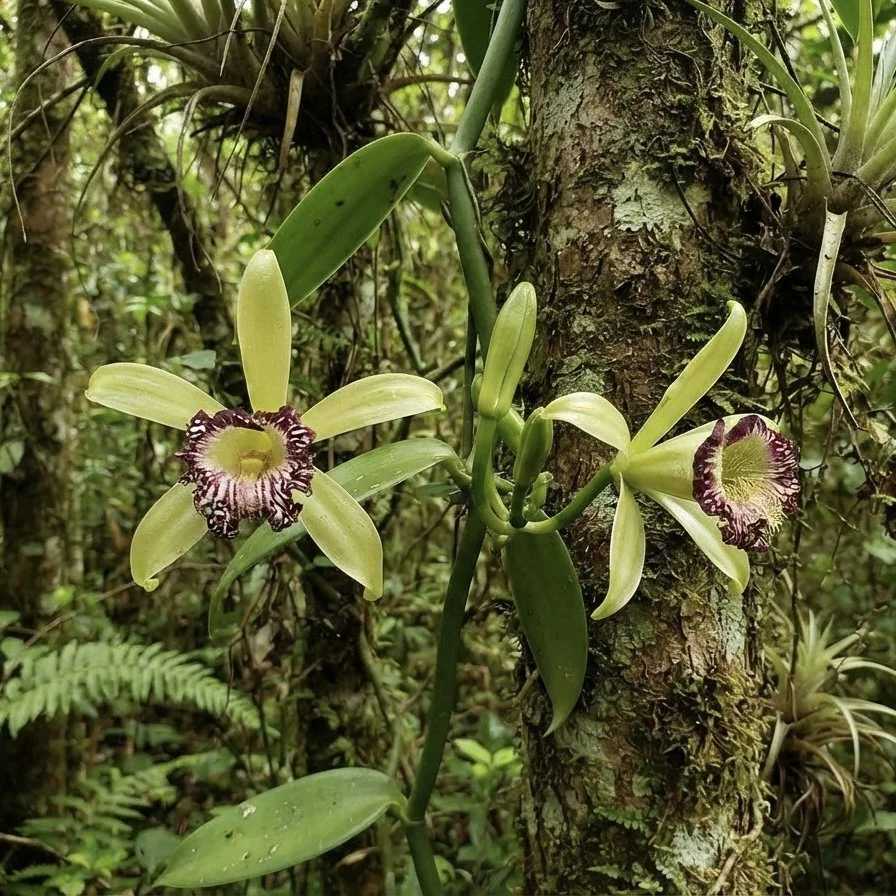
The blooms of Vanilla poitaei are stunning but ephemeral, typically opening for just a single day. The flowers measure roughly 2 to 3 inches across, featuring slender, waxy sepals and petals in shades of pale greenish-yellow. The true focal point is the deeply ruffled, tubular lip. The lip is primarily white but is spectacularly bordered by a rich, vivid margin of magenta or deep purple, often featuring a distinct crest of yellowish hairs in the center to guide native pollinators.
The Bean
When successfully pollinated, the short-lived flower gives way to a fleshy, cylindrical green seed pod. While V. poitaei is not cultivated for commercial vanilla extract like V. planifolia, its pods do share the genetic traits of the genus. If left to mature on the vine and then carefully cured, the pods develop a mild, sweet fragrance.
Growing & Care Instructions
Because it originates in the drier, limestone-rich scrublands of the Caribbean, Vanilla poitaei is somewhat more forgiving of missed waterings than its deep-rainforest cousins, provided its roots can breathe.
Light: Provide bright, filtered, or dappled sunlight. It naturally grows in more exposed scrubland than typical rainforest vanillas, so it appreciates strong light to trigger blooming, but avoid harsh, direct midday sun.
Support (The Host): This plant is a true climber and requires a sturdy, textured support. Use a rough-barked post (like oak or mahogany), a thick tree fern totem, or a wooden trellis. Loosely tie the vine to the structure until its aerial roots grab hold naturally.
Water & Humidity: Water thoroughly when in active growth, but allow the growing medium to dry out almost completely between waterings. Its succulent stems are designed to store water; constant wetness will rot the plant. Maintain ambient humidity around 60%-75%.
Potting Medium: Plant the terrestrial base in a highly aerated, extremely fast-draining mix. Use coarse orchid bark mixed with perlite and a bit of pumice or crushed limestone. Because it naturally scrambles over limestone outcrops, it prefers a neutral to slightly alkaline pH (around 6.5 to 7.5).
Temperature: This is a warm-growing tropical species. It thrives in temperatures between 70F and 90F. It can be grown outdoors year-round in USDA Zones 10-12. If you live in a cooler climate, you must overwinter the orchid indoors or in a heated greenhouse before temperatures dip below 50F.
Fertilization: Apply a well-balanced, water-soluble orchid fertilizer at quarter strength every two weeks during the active spring and summer growing season.
A 3 node cutting of a Vanilla poitaei vine.
Vanilla Poitaei (Poiteau's Vanilla)
Introduce a highly adapted, striking Caribbean native to your orchid collection. Vanilla poitaei is a spectacular, leafless climbing orchid that defies the traditional expectation of lush tropical vines. Perfect for the dedicated collector of rare botanical curiosities, this structural beauty offers an incredible story of survival and evolution.
A Botanical Curiosity: Brief History
Native to the coastal thickets, dry scrublands, and limestone forests of the Caribbean-including the Bahamas, Cuba, Hispaniola, and Puerto Rico-Vanilla poitaei was named in honor of the renowned French botanist Pierre Antoine Poiteau.
To survive in these seasonally dry, sun-baked environments, Vanilla poitaei evolved a brilliant physiological workaround: it shed its foliage. By relying entirely on its thick, chlorophyll-rich stems to photosynthesize, the plant drastically reduced its water loss while still scaling the harsh scrubland canopy. Today, it is highly prized by orchid enthusiasts who specialize in rare, drought-adapted species and those looking to preserve the fascinating genetics of Caribbean flora.
Plant Anatomy
The Vine
Often described as a "leafless" vanilla, Vanilla poitaei features thick, succulent, highly structural green stems. Any leaves the plant does produce are usually reduced to tiny, imperceptible scales that quickly drop off. The monopodial vine relies entirely on its fleshy stems to absorb sunlight. As it scrambles upward, it produces strong, tenacious aerial roots at the nodes to firmly grip tree bark or rocky limestone outcrops.
The Flower
The blooms of Vanilla poitaei are stunning but ephemeral, typically opening for just a single day. The flowers measure roughly 2 to 3 inches across, featuring slender, waxy sepals and petals in shades of pale greenish-yellow. The true focal point is the deeply ruffled, tubular lip. The lip is primarily white but is spectacularly bordered by a rich, vivid margin of magenta or deep purple, often featuring a distinct crest of yellowish hairs in the center to guide native pollinators.
The Bean
When successfully pollinated, the short-lived flower gives way to a fleshy, cylindrical green seed pod. While V. poitaei is not cultivated for commercial vanilla extract like V. planifolia, its pods do share the genetic traits of the genus. If left to mature on the vine and then carefully cured, the pods develop a mild, sweet fragrance.
Growing & Care Instructions
Because it originates in the drier, limestone-rich scrublands of the Caribbean, Vanilla poitaei is somewhat more forgiving of missed waterings than its deep-rainforest cousins, provided its roots can breathe.
Light: Provide bright, filtered, or dappled sunlight. It naturally grows in more exposed scrubland than typical rainforest vanillas, so it appreciates strong light to trigger blooming, but avoid harsh, direct midday sun.
Support (The Host): This plant is a true climber and requires a sturdy, textured support. Use a rough-barked post (like oak or mahogany), a thick tree fern totem, or a wooden trellis. Loosely tie the vine to the structure until its aerial roots grab hold naturally.
Water & Humidity: Water thoroughly when in active growth, but allow the growing medium to dry out almost completely between waterings. Its succulent stems are designed to store water; constant wetness will rot the plant. Maintain ambient humidity around 60%-75%.
Potting Medium: Plant the terrestrial base in a highly aerated, extremely fast-draining mix. Use coarse orchid bark mixed with perlite and a bit of pumice or crushed limestone. Because it naturally scrambles over limestone outcrops, it prefers a neutral to slightly alkaline pH (around 6.5 to 7.5).
Temperature: This is a warm-growing tropical species. It thrives in temperatures between 70F and 90F. It can be grown outdoors year-round in USDA Zones 10-12. If you live in a cooler climate, you must overwinter the orchid indoors or in a heated greenhouse before temperatures dip below 50F.
Fertilization: Apply a well-balanced, water-soluble orchid fertilizer at quarter strength every two weeks during the active spring and summer growing season.